Pharma's shift from SAS to open-source R has been building for years. Most organisations know they need to make the move. Fewer have a plan for harmonising their statistical computing environment (SCE): bringing SAS, R, Python and Posit into one governed operating model, at enterprise scale, in a GxP-compliant way, without disrupting the teams who depend on existing infrastructure.
The question has also moved on. Organisations now want to implement AI in their own systems, and to do it in a way that meets the validation, compliance and governance criteria set for them. That only works when the environment underneath is governed, reproducible and auditable.
Both are problems we built Coadun to solve.
What Coadun is
Coadun is a joint venture between Jumping Rivers and Achieve Intelligence. Jumping Rivers brings R and Python expertise, Posit infrastructure, and 10 years of experience helping data science teams move from experimentation to production. Achieve Intelligence brings enterprise architecture methodology and deep experience deploying GxP-compliant systems in the pharmaceutical data value chain.
Neither organisation delivers Coadun independently. The joint venture exists because the problem requires both.
Why the combination matters
The barriers to modernising a pharma statistical computing environment are not primarily technical. Stakeholder resistance, fragmented ownership, and the complexity of change control in regulated environments are the factors that stall most transitions.
Add validating R and Python packages against traditional processes, deciding what to migrate, maintain or retire, and manual work the existing system can't automate, and most SCE programmes stall before they scale. Achieve Intelligence has the methodology to address that. Jumping Rivers has the R and Posit depth to deliver the technical side at the same level of rigour.
Together, we close a gap that neither organisation could close alone.
How we work
Every SCE transformation runs in three phases:
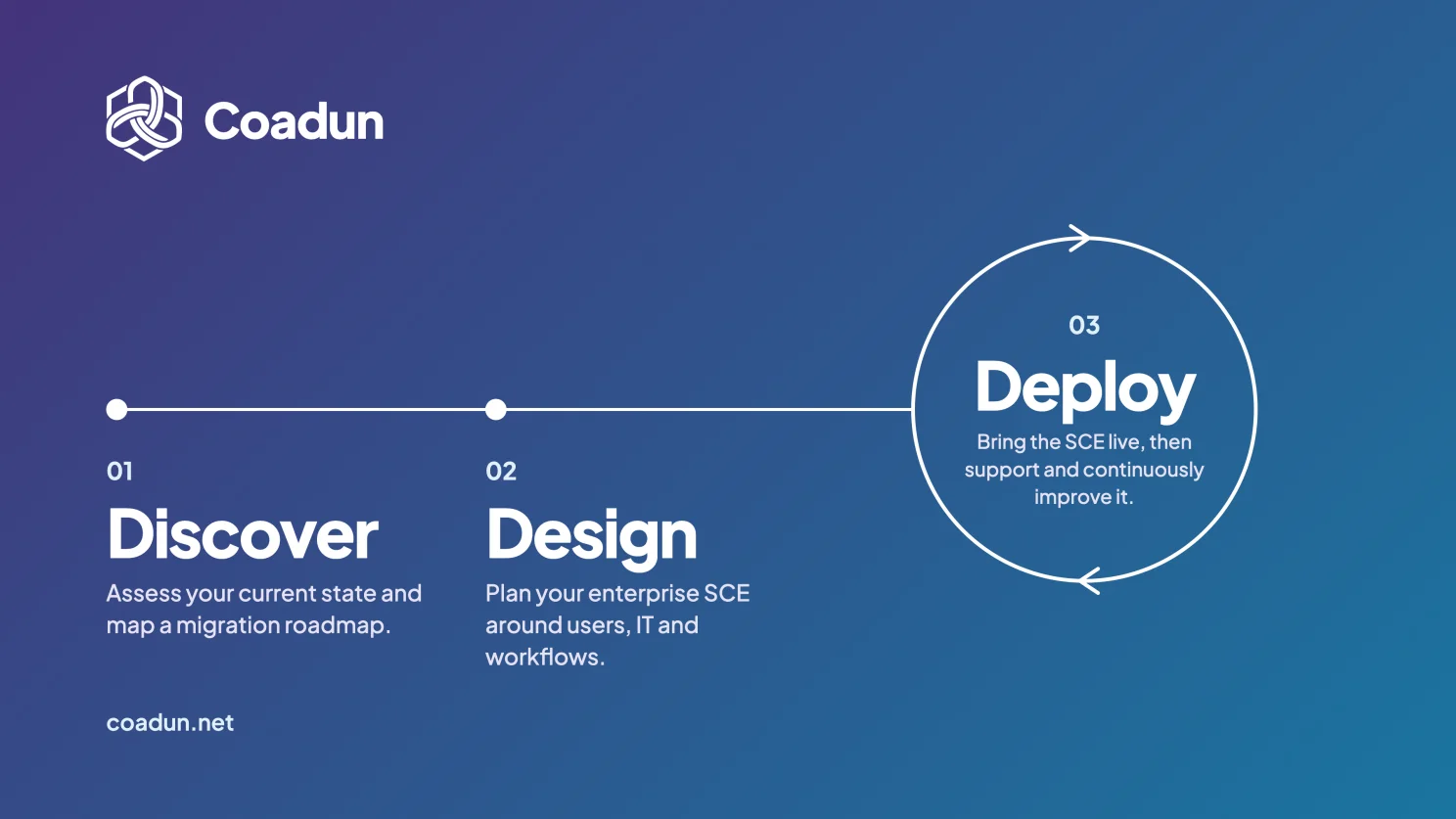
- Discover: we assess your current state, processes, governance, stakeholders and infrastructure.
- Design: we plan an SCE where Python handles automation and metadata, R handles analysis and reporting, and critical legacy processes stay in SAS or are transformed.
- Deploy: we build and test prototypes, establish package governance, develop validation processes based on your existing SOPs, and support onboarding and upskilling. When you're bringing AI into the SCE, we integrate it into the same governance and validation processes so it meets your criteria from day one.
Coadun is a modular service, not a black-box platform. You can take the full lifecycle or pick the phases you need, with long-term support, training, package qualification and steady-state SAS migration available after deployment.
Watch the conversation
Esther Gillespie, CEO of Jumping Rivers Ltd, and James McDermott, Managing Director of Achieve Intelligence, sat down to talk about what it takes to move a pharma organisation from SAS to enterprise R: the technical side, the human side, and why most transitions stall.
Watch the full conversation on YouTube.
Who we work with
We work with four types of organisation:
- Pharma teams mid-transition who have stalled or fragmented across multiple R deployments
- Larger organisations with siloed R environments across functions who need enterprise-wide governance
- Mid-size companies weighing the cost of traditional licensed solutions against a properly implemented open-source alternative
- Organisations implementing AI in their systems that need it to meet their existing compliance and validation criteria
What's next
Every engagement starts with an introductory session. We cover your current infrastructure, migration considerations, where AI fits, and how the engagement would address your organisation's specific requirements.
Book an introductory session at coadun.net or email hello@coadun.net.
Originally published on LinkedIn.